


 FREE Delivery over £35
 Unbeatable Prices
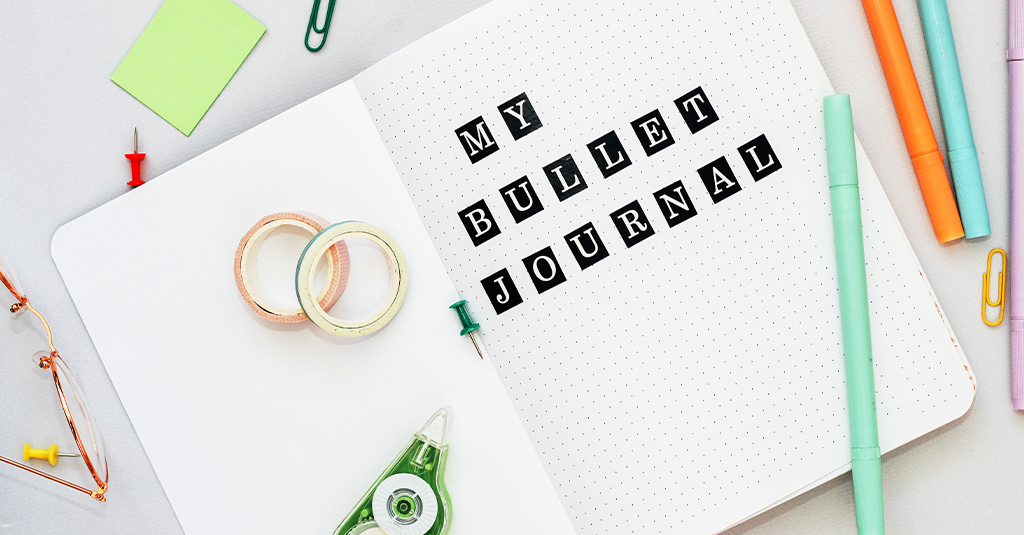
Bullet Journal Ideas & Template From Cartridge People
Organise your life by finding out what goes into a bullet journal with our ideas and templates to inspire you!
- What’s a Bullet Journal?
- Benefits of Bullet Journals
- The Structure
- How to Decorate Your Bullet Journal
- Bullet Journaling Strategies
- Bullet Journal Uses
- Layout Ideas
What’s a Bullet Journal?
Bullet journaling is a method of organisation invented by Ryder Carroll in 2013. A mindful practice, it’s an antidote to an always-online society filled with constant notifications.
Bullet journals combine elements of daily planners, to-do lists, diaries and habit trackers in one, analogue form – the humble notebook. Because you make a bullet journal yourself, they can be customised to match your needs. This makes them a great choice for anyone who’s looking for more control over their organisation, away from apps and other digital options.
What Do I Need for a Bullet Journal?
The list of things you’ll need for bullet journaling is very short:
- Pen
- Notebook
That’s it!
Anything else (like washi tape) is a nice-to-have bonus, but certainly not required.
Start Your Bullet Journal Journey!
Benefits of Bullet Journals
There are lots of ways a bullet journal can benefit your life, practically, creatively and mentally:
Unlimited potential for customisation
First and foremost, the bullet journal is customisable, designed to fit around your own personal routines, hobbies and interests. This means there’s no one perfect way to bullet journal.
While a blank page without any direction can seem daunting, this feeling is easily remedied by following one simple rule: start off basic and add in whatever detail you like as you go. If you want to add washi tape, add washi tape; if you want to doodle, feel free to do so. It is your bullet journal, after all.
Bullet Journals are better than digital alternatives
One distinct advantage a bullet journal has over a digital alternative is that it’s easier to retain information when written down. Through study, scientists have discovered that people tend to retain valuable information better when it’s been written compared to when it’s been typed. And because the process of writing in your journal is by hand, it encourages that retention.
Likewise, another benefit is that you never have to worry about your bullet journal running out of charge. Anyone who’s ever used a modern smartphone knows that at some point in the day they need to be recharged. Meanwhile, a bullet journal just goes on and on and on!
Bullet Journals can be set up quickly
Like we mentioned earlier, those wishing to get into the hobby only need a notebook and pen to start, so setup can be very quick. This extremely low barrier to entry makes the process much less intimidating.
The Structure
Those were the basics, but how exactly do you structure a bullet journal? Here are the pages you’ll want to include:
- Index
- Future Log
- Monthly Log
- Daily Log
The Index
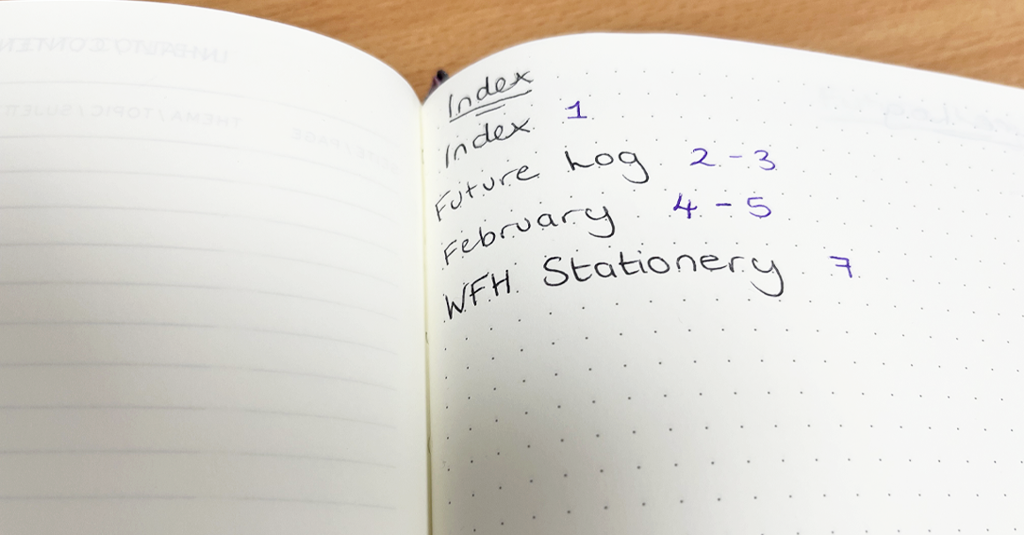
The index is found, as you’d expect, at the front of the journal and helps you find each section. As you add sections to the bullet journal, you’ll add an entry in the index with a corresponding page number. This allows you to find the page easily.
It’s important to remember, though, that not everything needs to go into the index. Daily logs, for example, probably shouldn’t go into the index. If you added an index entry for every daily log, your index could go on for 10+ pages!
Please Note: The index can be added to retrospectively, so don’t think you have to plan out your entire journal straight away.
The Future Log
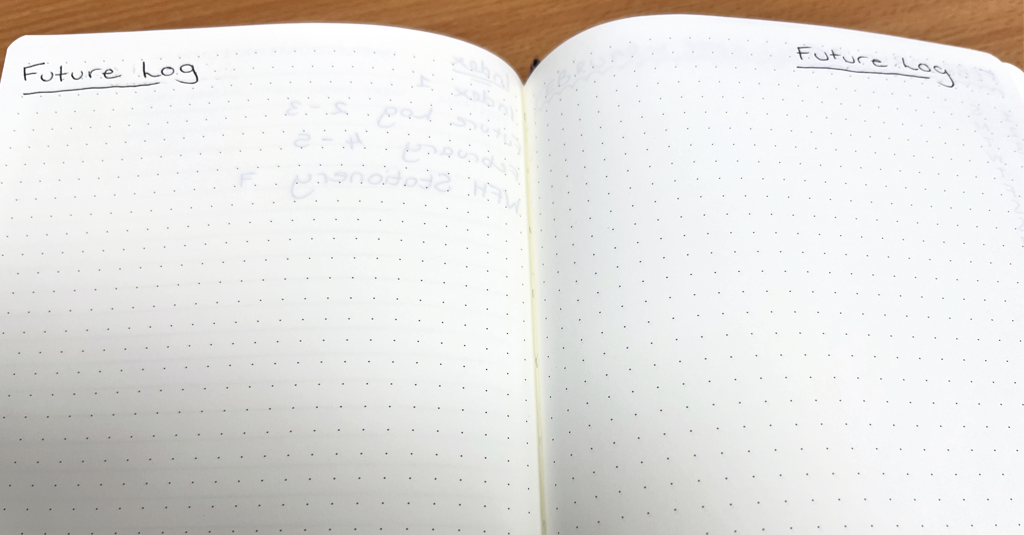
Here’s where any long-term goals or plans will live. Found towards the start of your journal, the Future Log allows you to plan ahead, ensuring any future plans aren’t forgotten.
The Monthly Log
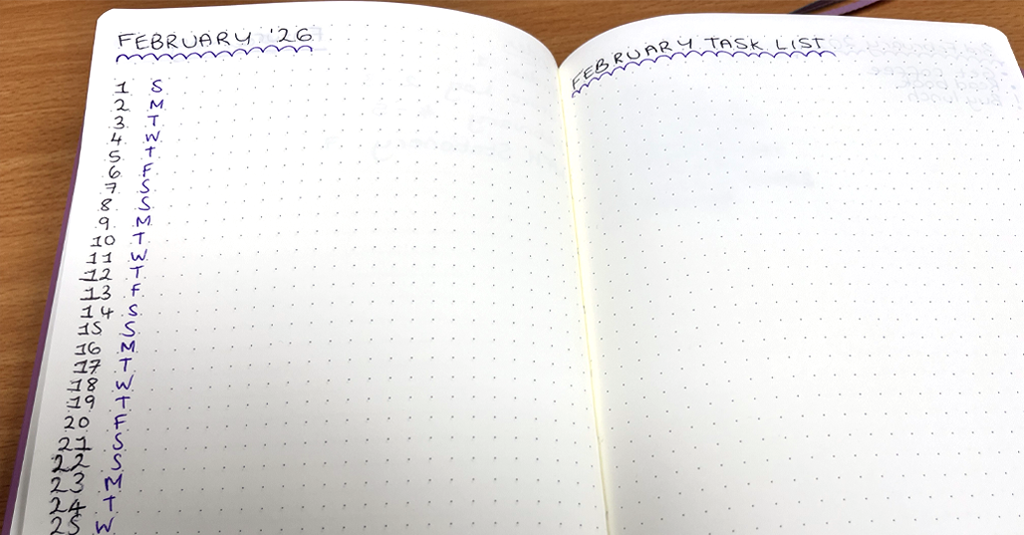
View the month at a glance with the Monthly Log. This section consists of a calendar and a task list for each month.
For the calendar section, start with the name of the month and then list the dates underneath, with space to write next to it. Then write what day of the week each date falls on. The Monthly Task List is simply a list of tasks and reminders for that month.
Having two pages per month set out this way allows you to immediately see how much you have to do that month via the calendar, and then go into more detail in the task list.
The Daily Log
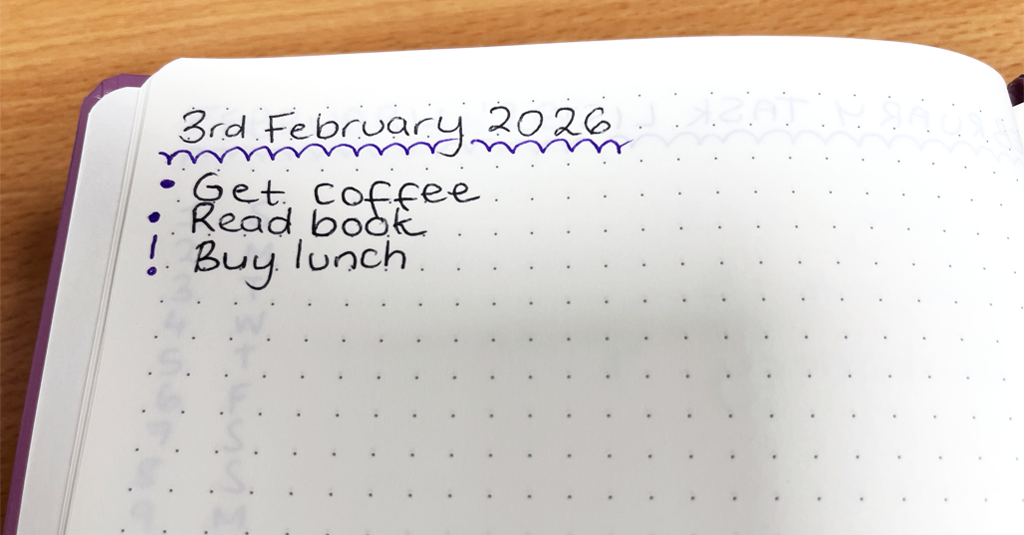
Use the daily log to note down tasks, events, appointments, to-dos and birthdays. This section is also a great place to treat your bullet journal like a traditional diary (just in a more condensed form), where you talk about any notable parts of the day, like starting a new TV series.
How to Decorate Your Bullet Journal
Now for the fun bit…decorating your bullet journal!
Embellishment
Embellishments are a great way of making a bullet journal your own. Whether you’re using washi tape, stickers, coloured paper or just doodling, little embellishments here and there help to really add personality and give a sense of ownership to a bullet journal.
But it’s important to remember that intricate, colourful designs take time and may not fit seamlessly into busy everyday life. Remember: simplicity is the key to consistency. It’s not that you shouldn’t decorate your journal. It’s just that massive artistic flourishes aren’t a requirement.
Signifiers and Keys
Signifiers are symbols that help you to quickly find the information you need. Normally, you’ll establish a set of signifiers in a key near the start of your journal which you’ll stick to throughout, enabling you to stay consistent while journaling.
While it’s important to use the system that works best for you, ideally you should keep the amount of signifiers you use to a minimum. You should also use signifiers that are linked to the concept you want them to represent (e.g., ‘!’ = important), for easier recall.
Collections
A collection is a list that can focus on anything from music/TV/film to places to visit. A great way to track media consumption over the year, it’s nice to look back on things that otherwise might get forgotten in the chaos of day-to-day life. As collections are groups of lists, it can be easy to fill up your journal with them, so exercise restraint.
Bullet Journaling Strategies
Here’s some advice to help you get the most out of your bullet journaling:
Migration
Migration is the system used to move tasks to the next month. All you have to do is look at the last month and see if there’s anything outstanding. You should do this each month, so nothing gets left behind.
Write a visual representation (like an arrow) to signify that the task has been moved to the next month. Then add it in as normal next month. Alternatively, cross it out if it’s no longer needed.
Threading
If your train of thought continues on another page that isn’t the next one numerically, you can use threading. Next to the current page number, simply draw an arrow and then write the number of the page where you continue.
Threading can be used in combination with your index page and stops you from being restricted by having to have all pages within a group on consecutive pages. This can be done retrospectively. Have a section that’s not finished after all? Use threading.
What to Avoid
When making your bullet journal, there are a couple of pitfalls that you want to avoid. These include:
- Don’t overcomplicate it – you’re more likely to stick to writing in your journal if it’s basic.
- Avoid distractions – keep the contents of your journal focused, so that it’s easier to look things up.
However, it’s completely customisable, so stick with what works best for you.
Bullet Journal Uses
Here are some practical use cases for bullet journals:
Habit Tracking
Whether it’s tracking exercise, water intake or cleaning, habit tracking can be broken down into weeks, months or days and provides a visual indication of how well you’re sticking to a habit.
Doing this makes it easy to spot patterns that emerge and when and why habits are successful or unsuccessful. Notice a gap in your tracker? It might be time to re-evaluate it.
Grocery and Meal Plans
After a long day at work, there’s nothing more annoying than having to think about what you want to eat. Take the pressure off by planning ahead.
Ideas
Use your journal to make a note of any random ideas you’d like to develop or at least go back to in the future. These ideas could be anything, from a short story you want to write to the colour you’d like to paint your kitchen.
Trip Planning
Going on holiday is supposed to be relaxing, but there’s always so much admin. Use your bullet journal to write down ideas of places to visit, create an itinerary or budget your spending.
You can also use it to write about moments from your holiday that you want to remember in the future.
Packing
Use your bullet journal to make a collection of important things you need to pack when moving or going on holiday.
Mood Tracking
Much like habit tracking, mood tracking in your bullet journal can be a great way to evaluate something over the long-term. Use a colour key for different emotions.
Layout Ideas
The Index (Template)
| Index | 1 |
| Future Log | 2 – 3 |
| February | 4 – 5 |
The Monthly Log Template
| 1 | S | [task/event] |
| 2 | M | |
| 3 | T | |
| 4 | W | |
| 5 | T | |
| 6 | F | |
| 7 | S | |
| 8 | S | |
| 9 | M | |
| 10 | T | |
| 11 | W | |
| 12 | T | |
| 13 | F | |
| 14 | S | |
| 15 | S | |
| 16 | M | |
| 17 | T | |
| 18 | W | |
| 19 | T | |
| 20 | F | |
| 21 | S | |
| 22 | S | |
| 23 | M | |
| 24 | T | |
| 25 | W | |
| 26 | T | |
| 27 | F | |
| 28 | S |
The Daily Log Template
3rd February 2026
| Get coffee | |
| Read book |
To Sum Up
The bullet journal is a great organisational tool, thanks to its ease of use and potential for customisation. Hopefully, we’ve provided some useful bullet journal ideas to get you started on your journey.
Shop the items you need to start your bullet journal adventure here at Cartridge People. From notebooks to pens and pencils.
About The Author
